Astro-Antipasto
Small Bites of Artemis, Challenger, Eclipses, Conjunctions, and Live Events

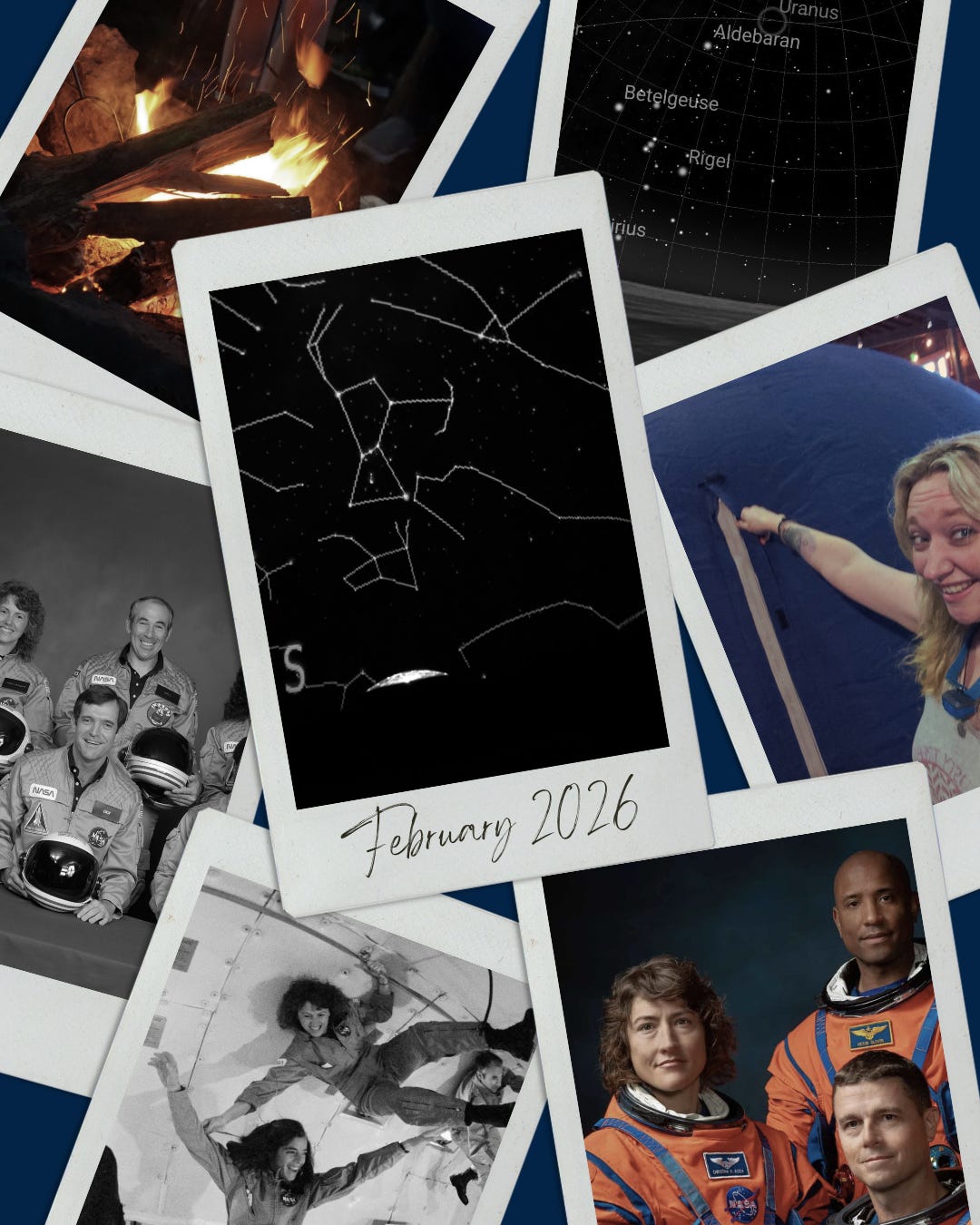
This month there is far too much to write about to narrow in on one or two topics, so I’ve whipped up a plate of appetizers with links to some main dishes. On the menu today:
Final registration for the March “Know the Night” live event
Planetarium updates
Upcoming eclipses
Two planetary conjunctions, and a major planetary alignment
February’s upcoming Artemis launch
A remembrance of fallen astronauts
Bon appétit!
Know the Night
One final plug for this event because it closes soon!
Celebrate the balance between darkness and light on the spring equinox with a little trip out to the wild woods of Vashon Island. We’ll gather around the fire as the sun sets, bask in the twilight listening for owls and watching for stars, then end the night playing with our non-dominant senses in the dark. Don’t want to catch the late ferry home? Stay the night in Camp Sealth’s nicest cabins, conveniently located walking distance from our fire pit, or bring a tent and stay the night for free! Bring friends and enjoy a beautiful, cost-friendly evening in the woods.
Join us for the evening of Saturday, March 21st. Register before February 21st!
Planetarium Updates
This month I got to fully set up the planetarium system at camp, and I’m happy to report that everything is in much better shape than I expected it to be! The dome is blessedly free of holes or major structural damage, the projector performed perfectly within the dome, and I was even able to give some small shows to my co-workers and a very excited child. I think the dome is a bit smaller than I’m used to, but it’s perfect for the projector resolution. I’m still building a box of preferred accessories, but I’m all set to teach, and am looking forward to doing some test shows with 6th graders this coming week.
With that all figured out, I can officially begin offering and presenting planetarium shows! If you would like a show at your upcoming event or party, feel free to check out my offerings, or reach out with questions about space and capacity.


Eclipse Season
It’s eclipse season again - one of the two times of the year when the moon crosses the ecliptic. And in each of those seasons there’s usually a solar and lunar eclipse of some kind.
This spring’s solar eclipse is going to be a bit underwhelming as far as eclipses go. Occurring on February 17th, this annular eclipse (meaning the moon appears smaller than the sun in the sky, leaving a ring around the moon and an incomplete eclipse) will only be visible in the southern hemisphere, and will only approach totality in Antarctica. You can view the map here.
However, the accompanying lunar eclipse on March 3rd should be pretty nice, with totality visible here in the Seattle area! (Clouds permitting, of course.) The next blog will be coming out at the same time as the eclipse (it is a full moon after all) so I may write about it again, but this is your heads up in case you want to plan anything. You can learn more about timing here.
Conjunction Junction
This month we have a really fun series of planetary events that should lead to some interesting viewing.
Feb 15: Conjunction of Neptune and Saturn: Neptune isn’t usually visible to the naked eye, so unfortunately, this isn’t the most visually exciting conjunction, but it is pretty cool to know that these planets will be in the same part of the sky. (A conjunction is when two bodies appear right next to each other in the sky or even appear to overlap.)
Feb 19: Mercury at Greatest Eastern Elongation: Mercury is also a hard planet to see, on account of it always being so close to the sun. But this month Mercury gets some space from the sun in the evening sky, and on this day it will appear about as far away from the sun as it gets in its whole cycle. This also means that it’s about to go “retrograde.”
Feb 26: Conjunction of Mercury and Venus: Venus is also an evening planet once again and will cross paths with Mercury as Mercury goes retrograde.
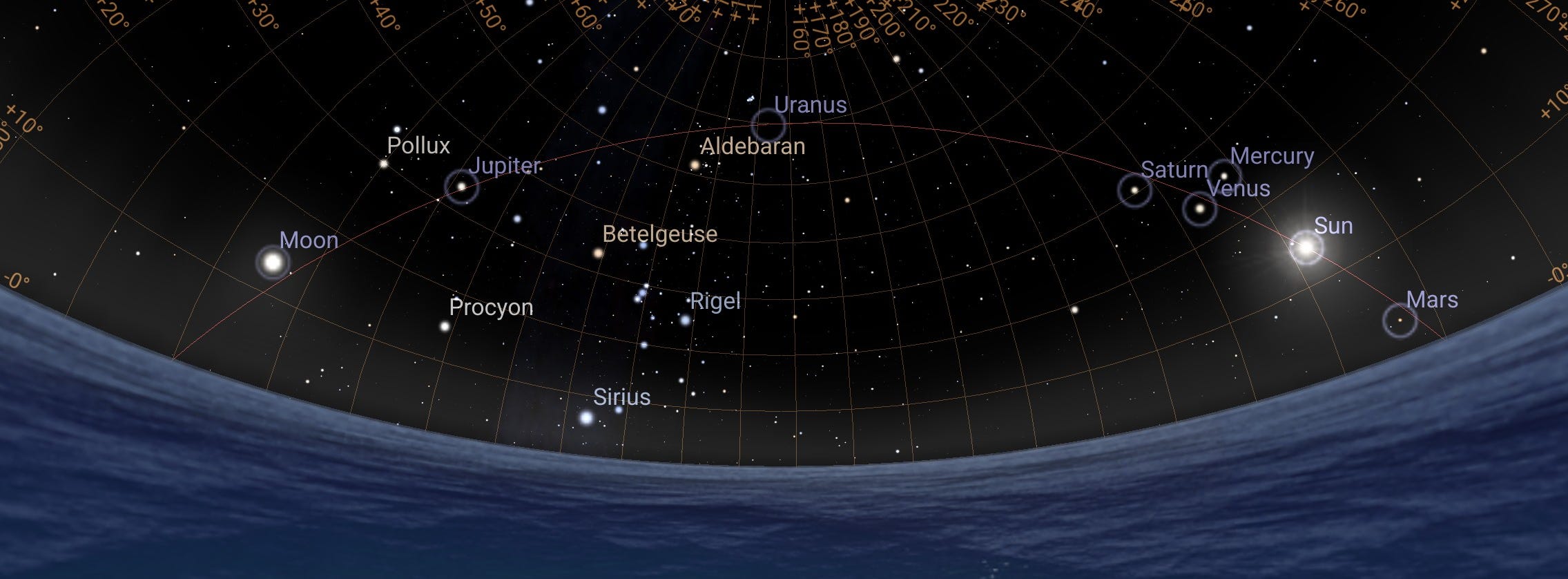
Feb 28: Major Planetary Alignment: Around this time of the month, Mercury, Venus, Jupiter, Saturn, Uranus, Neptune, AND the moon (at 90% full) will all be in the evening sky at once. The only planet missing the party is Mars - and only barely so. In fact, because it’s so close to the sun (on the morning side), all of the planets will be in the sky together just an hour before sunset. This doesn’t mean everything will be visible - Uranus, Neptune, and Mercury will be difficult to spot, but they’re still there. Technically this is also just the median date, and other days around this time will offer similar visibility but do try to catch Mercury before it slips back into the sunlight. Find more information here.
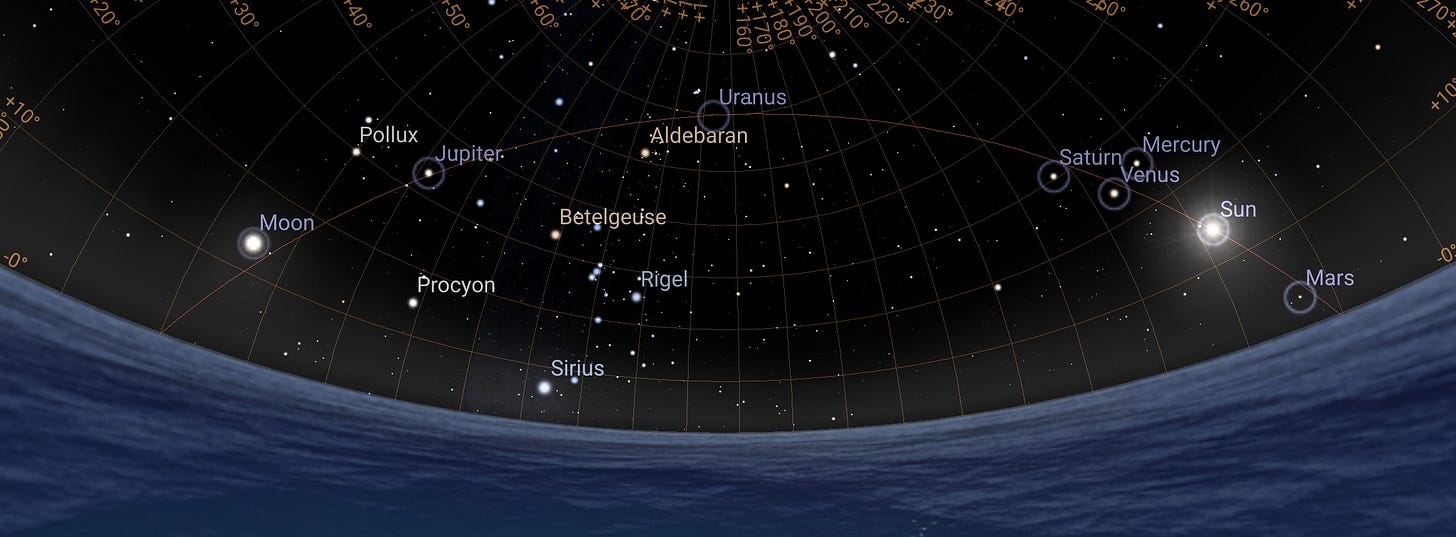
Screenshot from Stellarium mobile app, February 28, 2026. Neptune is too far away to be highlighted, but is somewhere near Saturn if you were to zoom in.
Back to the Moon with Artemis
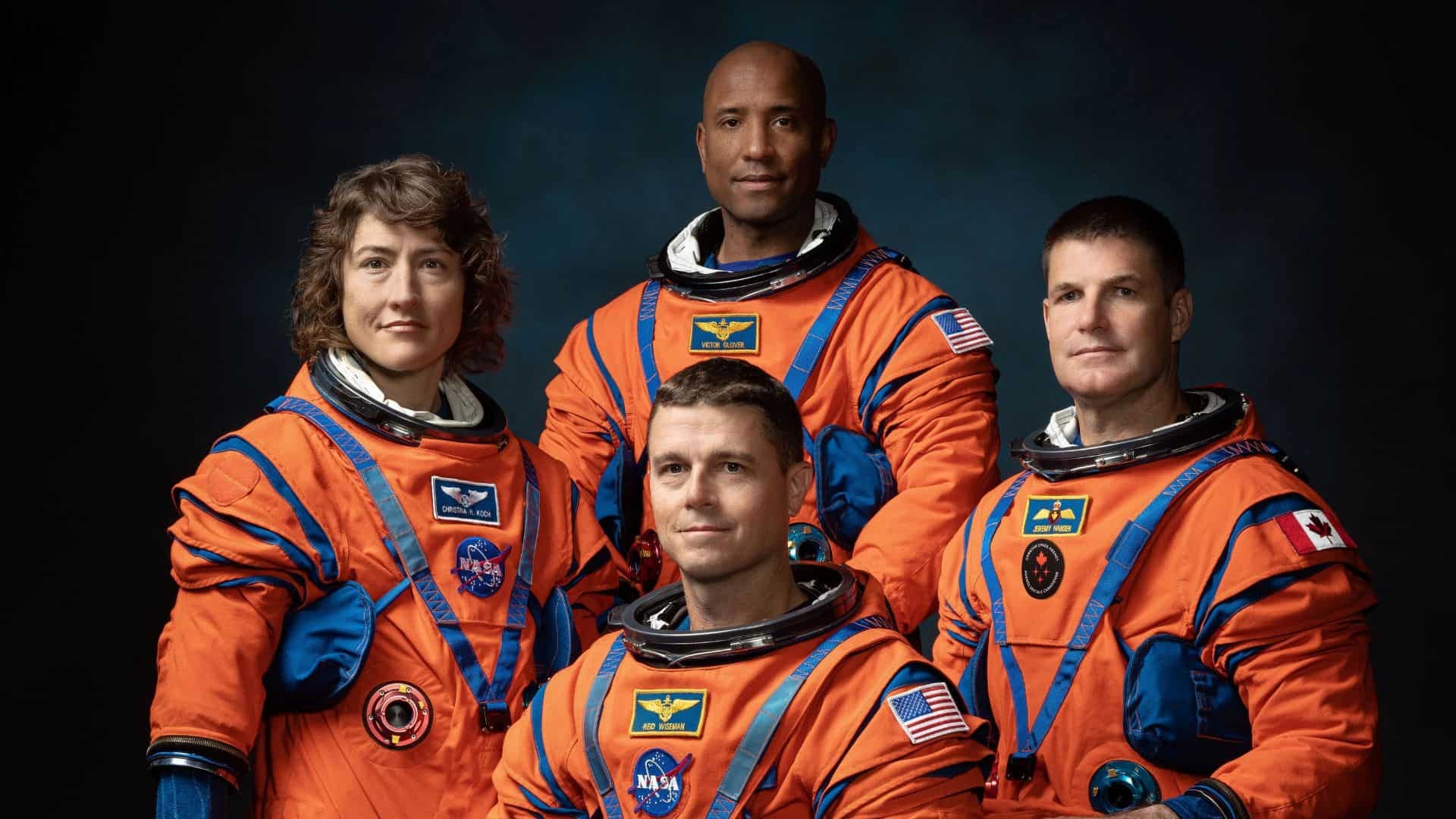
It’s FINALLY happening. After many years of speculating that perhaps we might head back to the moon with the Artemis missions, we can now say that it’s really happening. This month (hopefully), the first crewed mission in over 50 years (since 1972) is heading back to the general vicinity of the moon.
These four astronauts won’t land on the moon - that will be a future Artemis mission - but they will fly around the far side of the moon, performing tests and preparations for future lunar missions. On this 10-day mission, they have the potential to travel the furthest humans have ever been from Earth and return faster than anyone ever has.
The crew includes Commander Reid Weisman, Pilot Victor Glover (first person of color to the moon), Mission Specialist Christina Hammock Koch (first woman to the moon), and Canadian astronaut Mission Specialist Jeremy Hansen (first non-American to the moon.) They are currently in quarantine, with the earliest potential launch date after some wet-weather-scrubs being February 8. After February 11th, the moon will no longer be in a great position for launch, but there will be other launch windows in March and April.
You can read more about this mission here, here, and here.
A Remembrance of Fallen Astronauts
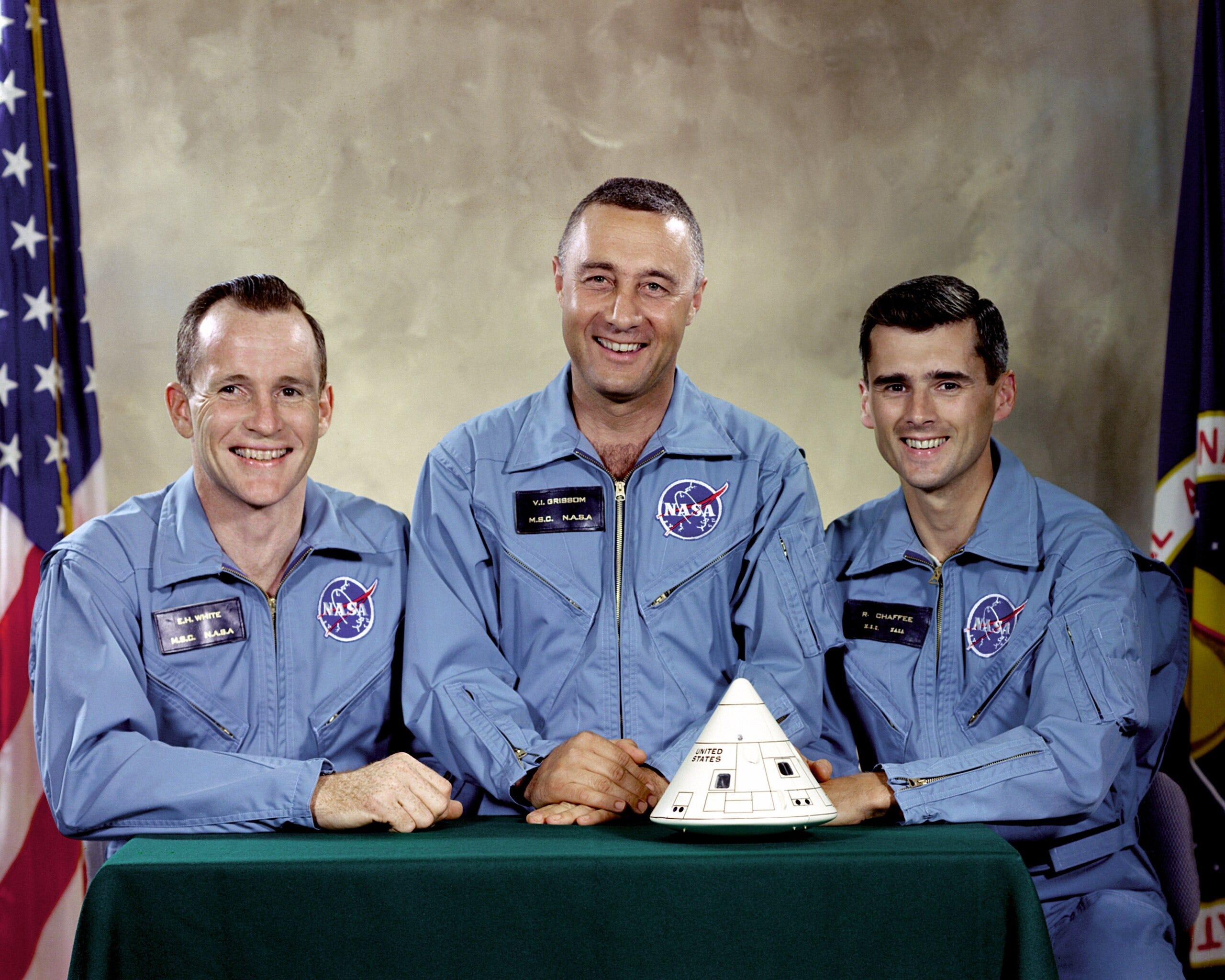
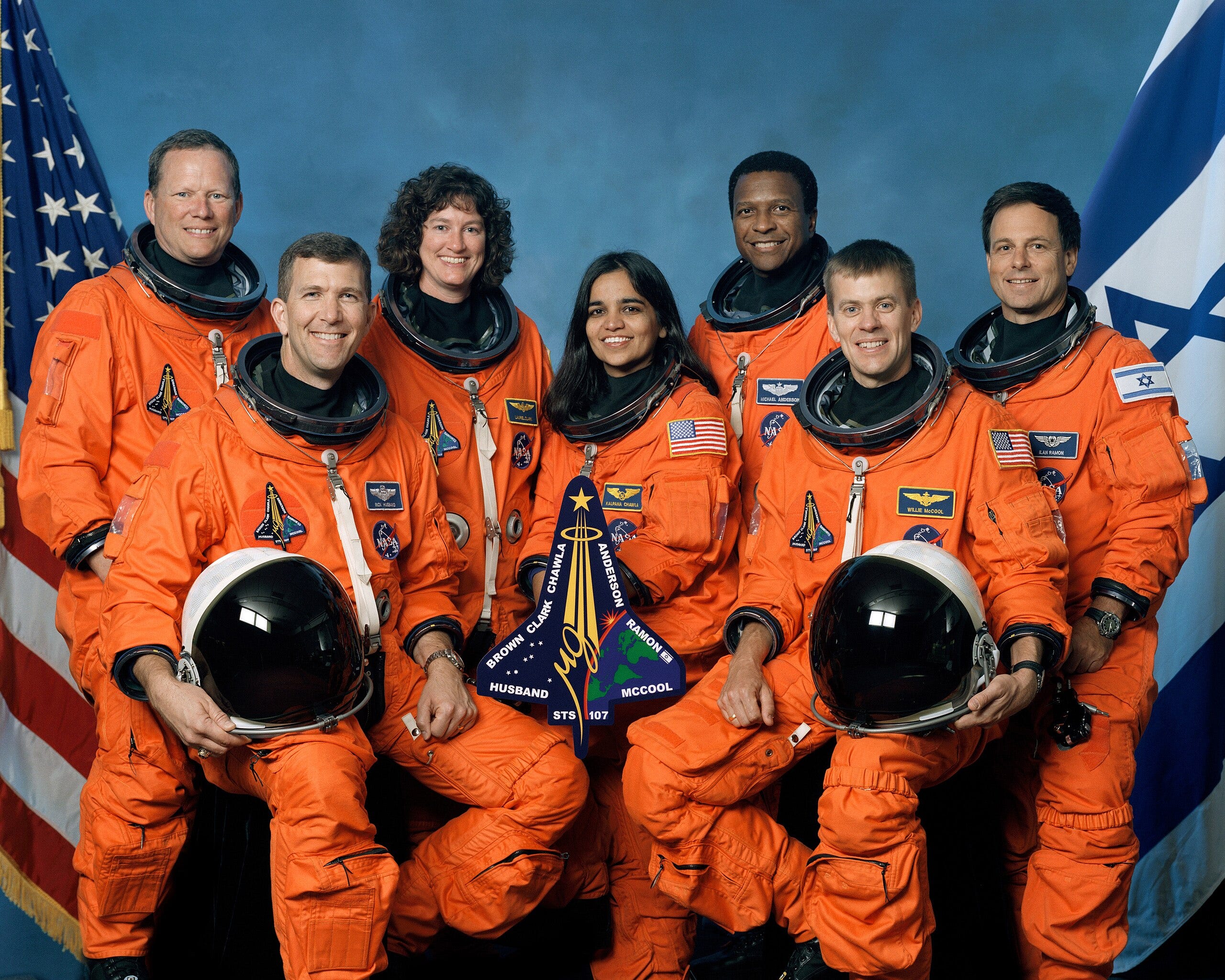
Earlier this week, January 28th, marked the 40th anniversary of the Challenger space shuttle disaster. In addition, January 27th marked the 59th anniversary of the Apollo 1 fire, and today, February 1st, marks the 23rd anniversary of the Columbia space shuttle disaster. It’s a doozy of a week in space history.
I’m ending this blog with this piece because I always have a lot to say on this subject — especially about Challenger. Even though it is the Columbia space shuttle that I remember watching fall apart on tv as a child, it’s the Challenger story that has become deeply personal to me. So, I’m going to honor the Challenger astronauts on this anniversary with a personal story.
Like many young people, I was fascinated by space. However, the idea of space as a dangerous place where astronauts go to die in horrific ways seemed universal in culture around me. As an existentially terrified child with no belief in an after-life, this put an early kibosh on any astro-aspirations I might have had. I threw myself into theatre, occasionally taking my friends out stargazing, diving into Star Trek, or taking an astronomy course.
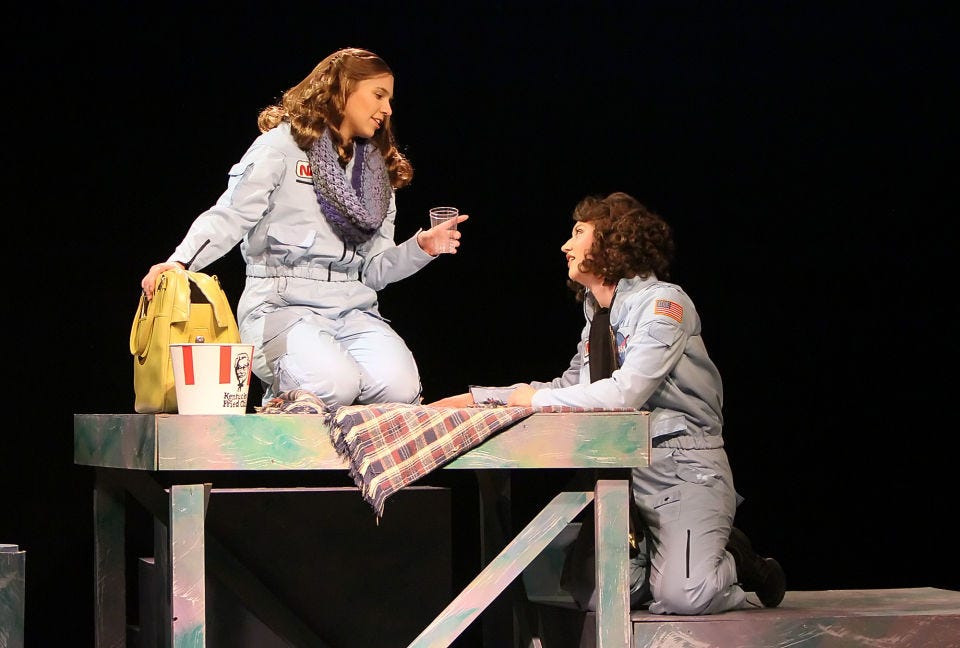
In the junior year of my Musical Theatre BFA, I auditioned for a devised show - a show that the actors and designers write and create together. The only thing we knew about it was the title: Challenger. I was anxious to confront the feelings of terror I had always felt around space disasters, but I knew this was the crossover I had always craved. I was offered a role on the team, and working on this show changed my life.
As we researched more about the STS-51-L mission, the crew, their assignments, the Teacher In Space Project, the political pressure to launch, and the engineering data behind the building and execution of the space shuttle launch system, it became increasingly clear that we did not just want to tell the same story of grief and terror that every documentary showed. These were unavoidable factors - but there was so much more to explore.
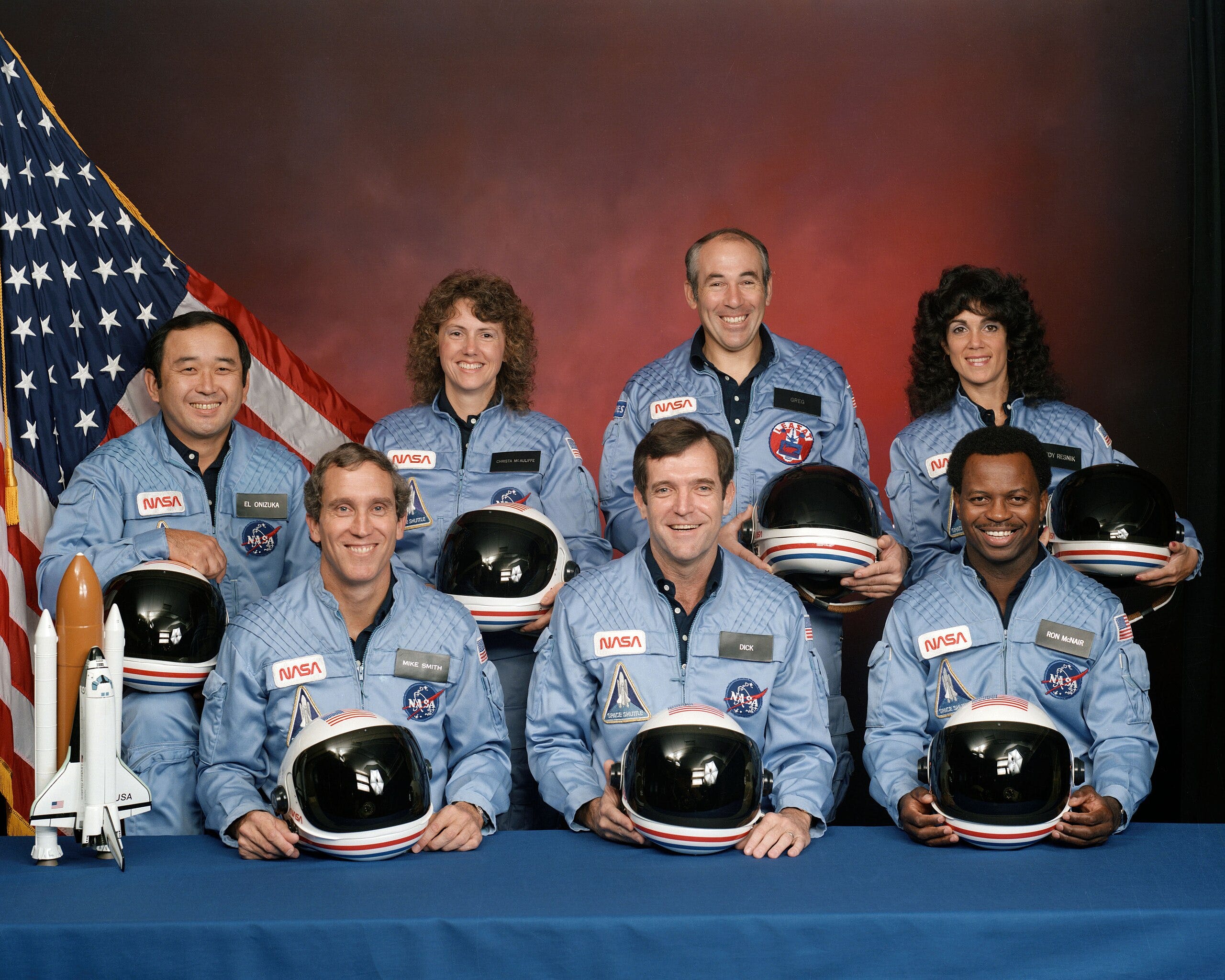
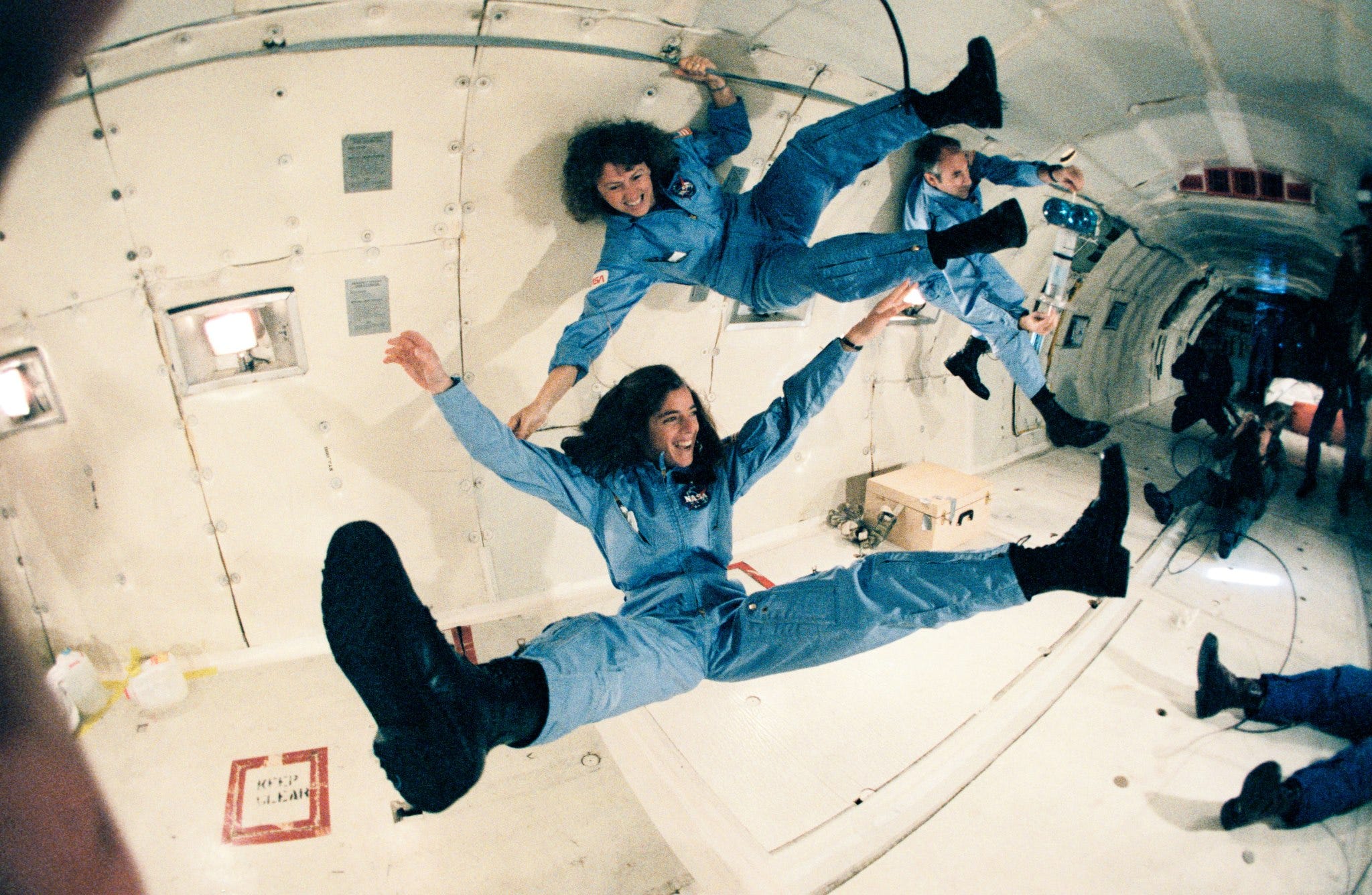
We decided to tell a story about wonder, female friendship, and legacy. The story of teachers Christa McAuliffe and Barbara Morgan moving through the TISP application process, training as civilians in a world of astronauts, being in awe of the prowess of Judith Resnick, and becoming friends. The story of how the families of Commander Dick Scobee; Pilot Michael Smith; Mission Specialists Ellison Onizuka, Judith Resnik, and Ronald McNair; and Payload Specialists Gregory Jarvis and Christa McAuliffe came together to create the Challenger Learning Center to continue to inspire youth to explore. The story of backup Teacher In Space Barbara Morgan vowing to become an astronaut, returning to space many years later, and inspiring other Teachers in Space like Dorothy Metcalf-Lindenberger. And through the researching, writing, and performance of this show, I came to understand how the crew might have felt — even though they did not think they would die that day, they knew that they could, and they decided to go anyway because they thought it was worth it.
This production brought me my best friend when we were both assigned to play Christa McAuliffe and Barbara Morgan. In the years after graduation when I needed a non-theatre job, I got to work at The Museum of Flight, continuing Christa’s mission by taking kids on simulated missions to the moon and Mars in the Seattle branch of The Challenger Learning Center. I also relished giving tours inside the shuttle trainer and pointing out the scuff marks made by the boots of every shuttle astronaut that ever trained, including the Challenger crew. I got to meet Barbara Morgan and for a time, regularly interacted with Dotty Metcalf-Lindenberger. As a person who continues to teach about space, it is the Challenger mission that changed the trajectory of my career and continues to be an important piece of my life.
Formative as this experience was, I still think it’s important to have nuanced opinions about space flight, crewed and uncrewed. It has always been - and continues to be - important to remember that pure research for the sake of wonder, inspiration, or discovery hardly exists where money and politics are driving and limiting forces. Even though there are good stories about incredible people to be found in the rubble of this disaster, it was still a disaster, and entire books have been written about the mechanics and pressures of how it came to be so.
For more on Challenger, I highly recommend reading the biography of Christa McAuliffe, I Touch the Future: The Story of Christa McAuliffe, and the autobiography of June Scobee-Rodgers, Silver Linings: My Life Before and After Challenger 7. You can also watch the National Geographic 30th anniversary documentary, or the Netflix 2020 docuseries.
This week we also honor the lives of Gus Grissom, Ed White, and Roger Chaffee, who lost their lives in the tragic Apollo 1 fire, and Rick Husband, William McCool, Michael Anderson, Kalpana Chawla, David Brown, Laurel Clark, and Ilan Ramon who perished aboard space shuttle Columbia.